Why your first line might be the reason your song never gets finished
Discover the simple system hit writers use by instinct to know exactly what their next lyric line should be. So you can finally finish the songs sitting in your Notes app (no rhyme generators, AI, templates or waiting for the muse).

7 lyric line types & Flow Rules, tested against 200+ recent hits across Pop, Country, Hip Hop, Rock and Worship.

Self-paced, 1 to 2 hours. Finish it this afternoon, use it in tonight's writing session.

Works in any genre, any language, any style. Your voice stays yours.
"I've now finished 3 songs which have been sitting for years and have an abundance of new ideas coming to me each day just by running the process in my head!"
Quigzy Balonton, Country, Pop/Country, and Gospel Songwriter
One payment · Instant lifetime access
You wrote a cracking first line last Tuesday...
You know the one. It arrived while you were brushing your teeth, and you sprinted for your phone with foam on your chin because it was that good.
Then you wrote three more lines.
Then you sat there. And sat there. And eventually went to make a sandwich, which is where most of my songs used to go to die.
Here's the frustrating part: your next line was already there. It was hiding inside the line you'd just written, waving at you. Nobody ever showed you how to spot it.
That's what this page is about.
It's a simple way of writing lyrics I picked up from sitting in rooms with Grammy-winning, genre-defining songwriters and watching them work. The writers behind today's biggest hits in Pop, Country, Hip Hop, Rock and Worship use the same thinking, usually without realising it.
This'll take me about 4 minutes and 52 seconds. Roughly the length of a pop song with a slightly self-indulgent outro.
Here's what's actually going on with your unfinished songs
You don't have writer's block. I'd bet good money on it.
What you've got is a Notes app stuffed with half-songs:
📱 Strong openings
📱 Promising choruses
📱 A bridge for a song that doesn't exist yet
And when you read your drafts back, the lines feel like a shopping list. Each one is fine on its own. Together, they stand next to each other awkwardly, like strangers at a wedding.
So you blame inspiration. You wait for the muse. The muse, as usual, is busy.
"I was lacking direction, actually frozen and blaming it on writer's block. Having a step-by-step process and knowing what comes next gives me a clear plan that I can execute, which has helped me immensely."
Maurice Bullock, R&B/Soul Songwriter & Producer
I'm going to show you how to finish those songs without rhyme generators, fill-in-the-blank templates, or letting a robot write the rest while you watch.
It works even if:
✓ You've never studied music theory
✓ You write in a genre I haven't mentioned
✓ You're worried any kind of structure will turn your lyrics into beige paint (it won't. And I'll get to that)
The idea is simple
Every lyric line signals what the next line should be.
Once you can read that signal, you stop guessing. You look at the line you just wrote and know, with surprising confidence, which kind of line belongs after it and which kind will stop your song dead in the street.
Most songwriting advice focuses on the lines themselves: better rhymes, sharper images, show don't tell. All useful.
But nobody talks about the bit between the lines. That's where songs either flow or fall over.
"I would always write image after image, but my songs didn't go anywhere. The course not only teaches seven types of lyrics, but which ones go together, which ones do NOT go together, and even when to break those rules. I was surprised after doing one of the course's exercises how my lyric had movement, and movement in the right direction."
William Dennett
My name is Nathan Eshman. I'm a Billboard-charting writer and producer, and I spent years as an A&R manager working alongside writers and publishers from Sony, Universal, Capitol CMG, Hillsong Music and more.
Here's an embarrassing confession for someone with my job title.
I used to have the exact same problem as you. I'd write a strong line, then hit a wall. I couldn't tell you what came next, or why a verse felt slightly off. I'd fiddle with it until I gave up.
Meanwhile, the great writers I worked with seemed to just *know*. They'd write a line and the next one would tumble out after it like it had been queuing politely the whole time.
It drove me up the wall, frankly.
Why this matters so much
A song that doesn't flow loses people.
Listeners don't think "hmm, the line types in verse two are mismatched." They just drift off and reach for the skip button.
Get flow right and your songs feel inevitable, like they couldn't have gone any other way. Get it wrong and even brilliant lines feel disconnected.
And finishing songs is the whole game. A finished, decent song beats a brilliant half-song every time. Nobody's ever cried at a wedding to a verse and a half.
What makes this different
I call it the Lyrical Domino Effect.
types of lyric line (I call them dominoes)

A set of Flow Rules showing which types naturally follow each other, and which combinations kill your momentum
"I would always write image after image, but my songs didn't go anywhere. The course not only teaches seven types of lyrics, but which ones go together, which ones do NOT go together, and even when to break those rules. I was surprised after doing one of the course's exercises how my lyric had movement, and movement in the right direction."
William Dennett
Instead of a tip, you get a decision system for your very next line.
And it isn't my opinion. I tested it against 200+ recent hits across Pop, Country, Hip Hop, Rock/Alternative and Christian/Worship.
Here's a quick taste. The first four lines of verse 1 of "Lose Yourself" by Eminem:
LINE 1
Line 1 is a Domino #3. His body's falling apart. Hands, knees, arms.
LINE 2
Line 2 is a Domino #3 again. Same type, but the camera moves in closer. Now you can see the mess.
LINE 3
Line 3 is a Domino #5. The flip. Calm on the outside, collapsing on the inside.
LINE 4
Line 4 is a Domino #2. The cost. The moment he needs the words, they're gone.
Two #3s stack the pressure. The #5 turns it inside out. By then, there's nowhere left to fall except down. Eminem didn't stumble into that order by accident.
"My ideas used to stop after two bars. Learning the Lyrical Domino line types helps me set up the next bars and think ahead while improving."
Patrick Pellacani, Reggae, R&B, and Rap Songwriter
Or take the chorus of "Rescue Me" by OneRepublic. Six lines, every single one Domino #7. On paper, a terrible idea. In practice, it's a chorus designed to refuse an answer, so the listener leans in waiting for one.
That's the bit that matters if you're worried about sounding formulaic. Once you understand the rules, you can break them deliberately, the way OneRepublic did.
It works even if your style is weird, wordy, minimal or somewhere off the map entirely, because it keeps your voice exactly where it belongs: in your song.
"Before learning the Lyrical Domino Effect, I often felt stuck trying to make every line sound clever, and my lyrics didn't always feel natural. It completely changed the way I approach writing. My lyrics flow more easily, feel more authentic, and I can develop ideas without forcing them."
Ze
It even works beyond English:
"I was first a bit worried that it would not work for me because of my language (I write lyrics in Swedish). But it worked really well. I had a song lyric that was totally stuck, but now it's done thanks to the Lyrical Domino Effect."
Per Svensson
"Learning the seven categories of lyrics in the Domino Effect gave me a clear vision of what, when and where to place lyrical content without overstuffing the verses with details."
Yannis Bakoulis, Indie Pop/Rock Songwriter (Greek Language Lyrics)
The above songs are just two examples...
The dominoes apply to all genres and writing styles.
You can find it in Country:
Take verse 1 of "Wildflowers and Wild Horses" by Lainey Wilson (Country)
The pattern: Domino #1 → Domino #3 → Domino #1 → Domino #4 → Domino #4 → Domino #2 → Domino #2
💡 The words stay calm, but the order underneath doesn't. Listen for the moment she stops describing the storm and plants her boots in it.
Pop thrives on it:
Check out the first 6 lines of verse 2 of "As It Was" by Harry Styles (Pop)
The pattern: Domino #2 → Domino #6 → Domino #2 → Domino #4 → Domino #4 → Domino #4
💡 One line lands and suddenly it isn't his voice anymore. The chain tells you exactly where. Can you hear it before you look?
Hip Hop uses it:
Here's the chorus of "Anxiety" by Doechii (Hip Hop)
The pattern: Domino #4 → Domino #4 → Domino #5 → Domino #2 → Domino #4 → Domino #2 → Domino #4 → Domino #4
💡 The same word keeps coming back, but it never does the same job twice. Count how many dominoes it plays.
Even Christian/Worship is built on the dominoes:
Sing the bridge of "That's My King" by CeCe Winans (Christian/Worship)
The pattern: Domino #4 → Domino #4 → Domino #4 → Domino #4 → Domino #4 → Domino #4 → Domino #4 → Domino #4
💡 On the surface, eight lines following the same line type. Underneath, the Domino Effect reveals a shift that turns a list into a declaration. Most people sing right past it.
Using this, you can...

Finish songs faster

Write lyrics that flow naturally and drag the listener along from line to line

Catch weak lines before anyone else hears them, which beats discovering them halfway through playing it to a friend who's politely nodding
"Writing lyrics used to take two, sometimes three hours. Now I get them done in around an hour and I can spend more time on melody and harmony."
Gianmarco Bonini, Pop Songwriter
"Where it used to take me months to years to write with consistent flow and prosody it now takes me hours to a few days"
Steven Carpenter, Country, Southern Rock, and Blues Songwriter
"I'm writing more than ever, and the quality has skyrocketed. It's brought me to a stage where I'm writing roughly 10 songs in the same amount of time it used to take to finish two or three"
Hakon Sveinsson, Indie Pop/Rock and Adult Contemporary Songwriter
There's something you should know about how this came to be
It wasn't some lightning bolt moment.
I watched the great writers around me work. I asked questions (probably too many; I suspect some of them hid when they saw me coming). I produced their demos and listened really hard.
I got slightly obsessed with what they were *thinking*, not just what they wrote. The finished lyric only tells you so much. The decisions behind it tell you everything.
Slowly, a pattern showed up in how every line pulled the listener into the next. At first it was a gut hunch. Then it kept being right. Song after song.
So I tested it properly, against 200+ recent hits across five genres. And it held.
That's when I knew I had to make it teachable, so everyday songwriters could use on purpose what the best writers use by instinct.
– OPTION A –
You could do what I did
Honestly, you could.
Spend years getting into rooms with professional writers. Ask endless questions. Produce their demos. Listen to the same verse forty times. Then pull apart a few hundred hits line by line and see if your hunch survives.
It's a fascinating way to spend a few years. I'd recommend it to anyone with plenty of patience and a very understanding family.
– OPTION B –
Or you could just have the whole thing, condensed
Honestly, you could.
The Lyrical Domino Effect is a self-paced lyric writing course that takes 1 to 2 hours.
Get through it in an afternoon and walk away knowing what your next line needs to do, in minutes instead of weeks of staring at the same three lines.
You can use this even if you've got 47 unfinished songs and a mild sense of shame about it. Especially then, actually.
"I've now finished 3 songs which have been sitting for years and have an abundance of new ideas coming to me each day just by running the process in my head!"
Quigzy Balonton, Country, Pop/Country, and Gospel Songwriter
"Now, I am revisiting old lyrics, notes, and ideas—helping me transform the trash and find a place for them to exist instead of dumping them. I've already gone back and reworked 4 or 5 lyric drafts for my upcoming EP using it."
Daniel Asturiano, Rock and Singer-Songwriter
Here's exactly what you're getting
No fluff. No three-hour intro about my childhood. Just this:
|
01 |
The 7 Lyric Types. Every domino explained in plain English: what it is, what it does to the listener, and how to spot it in your own lines. With real examples pulled from current hits, so you can hear each one working. |
|
02 |
The Domino Flow Rules. Which line types naturally follow each other, which combinations quietly kill your momentum, and when to break the rules on purpose (the way OneRepublic did). |
|
03 |
Verses: Step-by-Step Method. A clear process for writing complete verses, whether you're starting from a melody, a single line, or a half-finished draft that's been sulking in your Notes app since 2021. |
|
04 |
Choruses: Step-by-Step Method. Exactly what to put before your title and after it, so your hook lands with full weight instead of getting buried. |
|
05 |
Bridges: Step-by-Step Method. How to write a bridge that takes the listener somewhere new, then brings them home to that last chorus. |
|
06 |
Practice Exercises. Including one that works backwards from the last line of a verse, and one where you finish an actual half-written song from your drawer. |
|
07 |
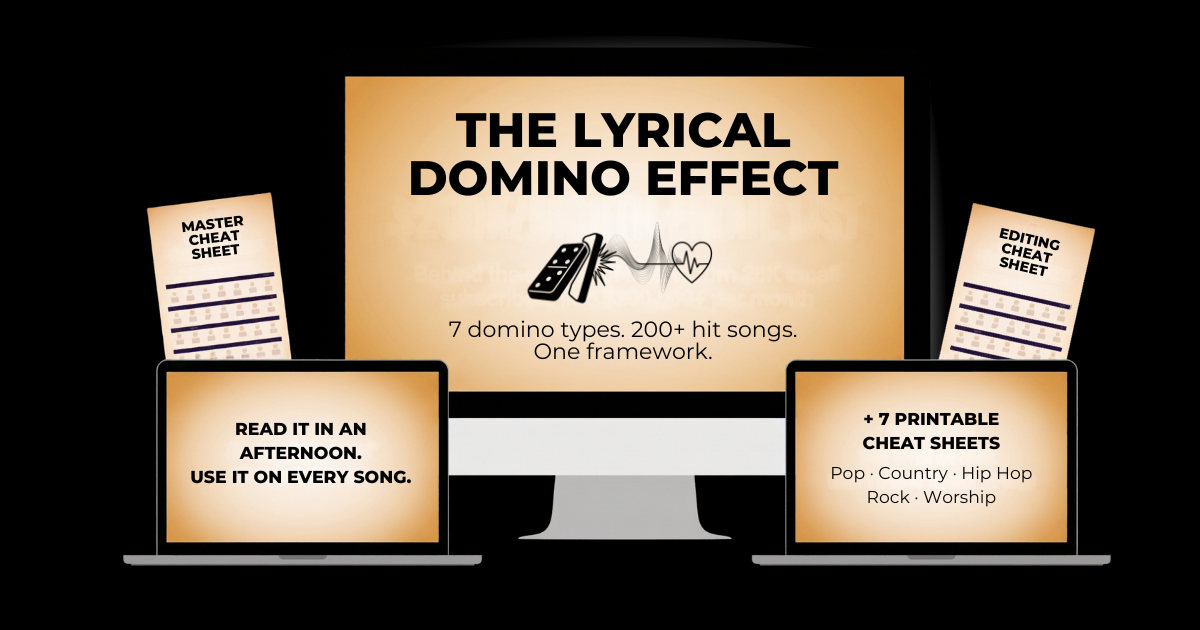
7 Printable Cheat Sheets. A Master sheet with the whole framework on one page, genre sheets for Pop, Country, Hip Hop, Rock/Alternative and Worship, plus an Editing sheet to check your lyric before anyone hears it. |
All of it self-paced. All of it doable in an afternoon.
Here's what changes once the dominoes click
✓ You'll know your next line in seconds, not weeks. Look at the line you just wrote, see what kind of domino it is, and you'll know what has to come after it. No more staring at line three until the sandwich wins.
✓ Your verses will finally go somewhere. No more shopping-list lyrics where every line is fine but nothing moves. Each line pushes the listener into the next, so they stay with you instead of drifting off.
✓ Your chorus will hit the way it does in your head. You'll know exactly what to put before your title and after it, so the hook lands with full weight every time (and you'll never again bury it next to the one line that quietly kills it).
✓ You'll write bridges that actually earn their place. Instead of a bridge that wanders off and never comes back, you'll write one that takes the listener somewhere new and brings them home to that last chorus hitting harder than ever.
✓ You'll turn your Notes app graveyard into finished songs. Those drafts you'd given up on? You'll see exactly where each one stalled and what it needs next, so you can finish them instead of starting yet another first line.
"Instead of slinging mud hoping something good would stick, I learned how to define the types of lines I'm writing. This helped me develop a new strategy to my writing and realized how many options I have that I didn't know I had!"
Steven P, Blues and Rock Songwriter

Here's the deal
I created this from years working alongside some of the best songwriters in the business, then tested it against hundreds of current hits.
I've cut out the academic theory and padding so you can get through it quickly and use it in your next writing session. Possibly even tonight, if you're keen.

Don't let the size fool you
It's short. One or two hours. That's on purpose.
But a lot went into those hours. Years of watching, asking, producing and analysing, boiled down to one simple shortcut to finishing the songs you start.

Please don't do what I did
You probably don't want to spend years pestering professional writers and dissecting a couple of hundred songs line by line. It's slow, with a lot of dead ends.
I made the mistakes so you don't have to. Everything you need is done for you, in one place.
So how much is it?
$37
One payment of $37. Lifetime access.
Unsure if it's worth a measly $37?
Fair enough. Here's what else you get:

A step-by-step method for writing complete verses, whether you're starting from a melody, a single line, or a half-finished draft that's been sulking in your Notes app since 2021.
Practice exercises that work backwards from the last line of a verse. Surprisingly useful when you know where you want to land but have no idea how to get there.

An exercise where you finish an actual half-written song from your drawer. By the end, there's a decent chance you'll have one fewer unfinished song and one more finished one.

7 printable cheat sheets, including genre sheets for Pop, Country, Hip Hop, Rock/Alternative and Worship, plus an Editing sheet that helps you know if a lyric hits the mark before anyone hears it.
"The Lyrical Domino Effect has helped me focus the direction and write lines that further the story, which makes fulfilling the intention of the song much easier. The flow of the story unfolds with more power, since I have more clarity about how to write to lead the listener where I want to take them."
Dharmika Henshel, Folk Songwriter
Why is it only $37?
Because I want this in the hands of as many songwriters as possible. I'd rather you spent your money on gear, studio time or a nice dinner to celebrate finishing a song.
It's also short and focused. You don't need a 40-hour masterclass to learn which line comes next. You need a clear framework and some practice. No point charging you for hours you don't need.
"Before I just had lines of random rhyme that didn't have a structure that was worth pursuing other than a creative exercise. Now I can go back to them and understand their weaknesses and correct them. Definitely worth the money."
Nick Huonder, Folk Songwriter
If you want to finally finish the songs you start...
...and write lyrics that flow so naturally the listener can't help getting pulled along, this is for you.

Put it this way
$37 is barely a few packs of decent guitar strings. The ones you'll snap at 1am, right as the good idea arrives.
Except this gets you a framework you'll use on every song you write from now on. And it won't snap.
Everything you get
|
✓ THE 7 LYRIC TYPES ($37) |
|
✓ THE DOMINO FLOW RULES (Included) |
|
✓ VERSES: STEP-BY-STEP METHOD (Included) |
|
✓ CHORUSES: STEP-BY-STEP METHOD (Included) |
|
✓ BRIDGES: STEP-BY-STEP METHOD (Included) |
|
✓ PRACTICE EXERCISES (Included) |
|
BONUS #1: MASTER CHEAT SHEET. The whole framework, ready to print and pin to your wall so it's in sight every session. (Worth $21) |
|
BONUS #2: POP CHEAT SHEET. The moves pop's biggest hooks run on, checked against hits from artists like Ed Sheeran, Taylor Swift and The Weeknd. (Worth $21) |
|
BONUS #3: COUNTRY CHEAT SHEET. The storytelling rules Morgan Wallen, Luke Combs and Zach Bryan write by, broken down so your next line comes naturally. (Worth $21) |
|
BONUS #4: HIP HOP CHEAT SHEET. The bar-building patterns behind hits from Kendrick Lamar, Drake and Doechii, decoded so your bars land with real weight. (Worth $21) |
|
BONUS #5: ROCK/ALTERNATIVE CHEAT SHEET. Where bands like Imagine Dragons and Twenty One Pilots bend the normal rules on purpose, and how to bend them yourself without losing the plot. (Worth $21) |
|
BONUS #6: CHRISTIAN/WORSHIP CHEAT SHEET. The patterns behind songs from artists like Elevation Worship and Brandon Lake, the kind a whole congregation sings back from memory. (Worth $21) |
|
BONUS #7: EDITING CHEAT SHEET. Know if your lyric hits the mark before anyone hears it, and save yourself hours of second-guessing. (Worth $21) |
|
Every genre cheat sheet includes that genre's most common domino moves, its own bonus line types, and mini methods for building verses, choruses and bridges the way that genre actually writes. |
Why you should grab it now
There's no countdown timer on this page. No price jumping up at midnight.
But think about how tomorrow goes if you don't.
Same Notes app. Same half-songs. Same brilliant first line from last Tuesday, still waiting for a second one that isn't coming.
Or you spend an hour or two with the Lyrical Domino Effect this afternoon, open one of those drafts tonight, and finish it.
Not "make progress on it." Finish it.
The songs in your drawer have waited long enough. One of them could be done before you go to bed.
What you'll notice in your very next song
Here's what tends to happen.
You sit down to write. A line lands. And instead of staring at it, waiting for the muse to pop round, you'll see what kind of domino it is. Then you'll feel the pull toward the next one.
You'll catch yourself about to stack two lines that don't belong together, and swap one out before it costs you the verse. You'll put the right line next to your chorus title and feel the whole thing click into place. You'll write a bridge that wanders off, takes the listener somewhere new, and actually comes home.
Then you'll play it back and hear it. Each line tipping into the next, right down the chain.
That's the dominoes working. It's a slightly strange feeling the first time. A very good one, especially if you've spent years on the other side of it.
"My struggle was finding lines that make sense without feeling like I was just forcing ideas into a rhyme. With the Lyrical Domino Effect, I have a better grasp of what comes next for my verses. Where my songs had no direction they now flow better, make more sense, and hit better emotionally."
Bob Shepard, Country & Americana Songwriter
Your drawer of unfinished songs is waiting
Somewhere in there is a song that only needs its next line.
You've got the first one already. Let me show you how to find the rest.
"My biggest struggle was getting stuck after writing a line or two, as well as lacking confidence in where to take a song idea. The whole course has helped. Since using the Lyrical Domino Effect, I can write more freely and have a better understanding of what comes next lyrically."
Stuart York, Folk/Punk Songwriter
Nathan Eshman
Inspire the Song
P.S.
Picture this: it's tonight, you open that draft with the brilliant first line from last Tuesday, and for once you know exactly what the next line needs to do. Then the one after that. Then you're singing a finished song back to yourself before bed. That's what an hour or two with the Lyrical Domino Effect gets you, for $37 and lifetime access. Grab it now and finish one tonight.
Still on the fence? Here are some FAQs
No theory to sit through and forget. The worksheet has you writing an actual section of your song while you learn the framework — so by the end, you're not holding notes, you're holding a lyric.
Yes. The seven Domino line types are universal. That's why folk, punk, R&B, reggae and blues writers are already using it (read their reviews above). What shifts between genres is how the types get used, and the five genre cheat sheets cover Pop, Country, Hip Hop, Rock/Alternative and Christian/Worship.
No. This isn't 'how to rhyme'. It's the pattern behind why hits move and yours might not. The more you've written, the more lines you'll recognise breaking the rules — before you even know the rules. That's the gap between good and unmistakable.
Opposite. Right now you're guessing — which is where songs start sounding the same, because you default to what's safe. Knowing the pattern means you can break it on purpose. That's the difference between a cliché and a chill-moment.
Yes. Works from a single lyric line, a melody with no words, or a half-finished verse stuck in a drawer.
1-2 hours to get through the content. One writing session to feel it click.
It's a tool, not a book. The Cheat Sheet is built to sit on your wall and get used every session, every song, from here on.
There's a set of questions inside the course for exactly this moment. Short version: check if your instinct actually belongs to a different genre first. If it still feels right after that, trust it — as long as you can explain why it works.
I want this to be a win for you. So as you go through the course, if you have questions or need clarification, email me at contact@inspirethesong.com. I'm here to help.
One payment · Instant access